

Reviewed · NASHVILLE HISTORY TOURS
Civil Rights Tour Of Nashville
Nashville’s civil rights story is not a side note to its music history. This walking tour follows the student-led protests that helped put the city at the forefront of the movement, with a stop at the Woolworth lunch counter where sit-ins took place.
I like the focus on specific places, especially Woolworth and the Civil Rights room at the city library, and the chance to hear how students organized nonviolent protest. Guide Chiquita is named in connection with the tour, and her account of the sit-ins and the planning behind them drew especially warm praise.
One consideration: at $298 per person, this is a costly two-hour walk. The tour description also calls it 1.5 hours in one place, and its accessibility details conflict, so check those points before booking.
- Woolworth’s lunch counter: Sit at the counter associated with Nashville’s sit-ins and consider how an ordinary lunch spot became a center of protest.
- Student-led activism: Learn how students at Nashville’s historically Black universities helped lead nonviolent demonstrations in the 1950s and 60s.
- The library’s Civil Rights room: See a dedicated space in the city library that connects Nashville’s story to the wider movement.
- A guide-led account: Chiquita is praised for telling the story of the sit-ins and the organizing behind them.
- A different side of Music City: The route pairs familiar downtown ground with lesser-known places tied to the fight for equality.
- Practical checks: The listed duration varies between 1.5 and two hours, and the accessibility information is inconsistent.
Nashville beyond the country-music story

It is easy to arrive in Nashville with a playlist in mind. This tour asks you to make room for another essential part of the city: the student activism that shaped its role in the Civil Rights Movement. In the 1950s and 60s, students at Nashville’s predominantly Black universities led nonviolent protests, including sit-ins that challenged segregation in public spaces.
That history is not presented as a distant chapter belonging only to one community. The tour connects the local struggle to American history more broadly, then considers how questions of race and equality continue to matter. You come away with more than a list of dates and names: the aim is to understand how organized action took shape in particular places.
The emphasis on Nashville makes this a useful choice if you already know the city’s music landmarks and want a fuller sense of what happened here. It also works as an introduction if this is your first visit. A guide can give context to streets and buildings that might otherwise look like ordinary downtown scenery.
Starting at the Nashville Visitor Center
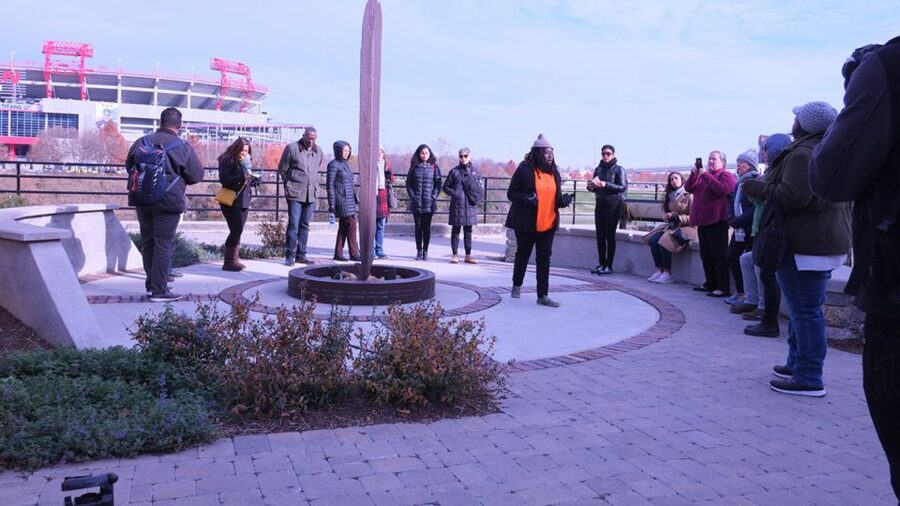
The meeting point is by the front door of the Nashville Visitor Center, at 501 Broadway. That central address is handy if you are already exploring downtown, but plan to arrive ready for a walk rather than expecting a seated museum visit. Comfortable shoes are specifically recommended.
The tour is described as walking, with stops at local sites and lesser-known places connected to the movement. The exact route and the amount of time spent at each stop are not specified, so treat the walk as a guided overview rather than a fixed sequence of attractions with set visit times.
There is a small timing wrinkle worth sorting out before you book. The activity information gives a duration of two hours, while the description of what to expect calls it a 1.5-hour walking tour. Starting times depend on availability, so check the current time slot and confirm the expected length if your day is tightly planned.
More history tours in Nashville:
- Belle Meade Guided Mansion Tour with Complimentary Wine Tasting
★ 4.5 · 2,189 reviews - Civil War Tour with Lotz House, Carter House & Carnton Admission from Nashville
★ 5.0 · 522 reviews - Journey to Jubilee Guided Tour at Belle Meade with Wine Tasting
★ 4.5 · 396 reviews
The sit-ins and the Woolworth counter
The most vivid stop is the former Woolworth’s, where the tour focuses on the lunch-counter sit-ins. The counter is more than a photo opportunity. It gives you a concrete place to think about the courage, discipline, and planning behind a protest that asked people to confront segregation through nonviolent action.
The tour description invites you to sit at the infamous counter. That detail matters: you are not only hearing about a political campaign in the abstract, but encountering the kind of everyday setting where the fight for equal treatment played out. The new Woolworth represents the change activists worked for, while the site itself keeps the history close at hand.
Chiquita’s account of the sit-ins is a particular draw. Her telling has been praised for covering not only the protest itself but also the organization that made it possible. That is the kind of perspective I value in a walking tour: it shifts attention from a dramatic moment to the people who planned, sustained, and carried out the work.
The experience is not a substitute for a longer study of the movement, and the supplied details do not promise a deep visit inside every site. But for a short tour, the counter offers a powerful anchor. It helps you picture how a local campaign could become part of a much larger national struggle.
The library’s Civil Rights room

Another notable stop is Nashville’s city library, described as a beautiful building with a Civil Rights room. The contrast is useful. After hearing about protest in a lunch-counter setting, you can encounter a space devoted to preserving and presenting the history.
The available details do not spell out what is displayed in the room or how long the tour spends there. Go in expecting a meaningful stop, not a guaranteed lecture on every object or a long independent visit. If you want to explore the library at greater length, leave time in your schedule to return on your own.
Together, Woolworth and the library give the tour two different ways to approach the story: one tied to the daily act of refusing segregation, the other to remembering and interpreting the movement. That pairing helps make the subject tangible without suggesting that one short walk can cover it all.
The student movement and Nashville’s wider story
The tour’s broader context is the role Nashville students played in the 1950s and 60s. Students at the city’s predominantly Black universities led nonviolent protests, making local activism central to the city’s place in civil rights history. The tour presents their work as organized action, not a sudden burst of courage without preparation.
That distinction is worth listening for. Protests are often remembered through a few bold images, but movements depend on people coordinating, making choices, and returning to the work. The account of the sit-in organization is one reason this tour can be valuable even for visitors who already know the basic outline of the Civil Rights Movement.
The route also promises local hideaways and uncommon sights, offering an off-the-beaten-path view of Music City. The exact sites are not listed, so I would not book on the assumption that you will see a particular set of hidden locations. Instead, take that promise as a chance to encounter parts of Nashville connected to the story beyond the best-known downtown stops.
More tours in Nashville:
- Nashville Hop On Hop Off Trolley Tour
★ 4.5 · 5,643 reviews - Nashville: Food Tour with 5+ Tastings of Local Delicacies
★ 5.0 · 2,704 reviews - Best of Nashville City Sightseeing Tour on Double Decker Bus
★ 4.5 · 2,601 reviews - Explore the City of Nashville Sightseeing Tour by Golf Cart
★ 5.0 · 2,544 reviews
A tour that links past and present
The tour asks you to consider parallels between the movement’s history and current questions around diversity and inclusion. That can make the experience feel immediate, but it also means the subject is not presented as safely finished. You are invited to think about what equality has meant in different periods and what activism asks of people now.
That reflective angle suits visitors who want more than sightseeing. It may be less appealing if you are looking only for a quick, light introduction to Nashville or a tour centered on music venues. The subject is serious, and the value comes from giving it attention rather than treating each stop as a backdrop for a snapshot.
The tour also makes a useful point about whose history is considered American history. Nashville’s civil rights story is part of the country’s shared past, not a separate subject to be cordoned off. That framing gives the walk a clear purpose: learn the local story, then see how it connects to the broader one.
Is $298 a fair price?
At $298 per person, the price deserves a careful look. A professional guide and any applicable entrance fees are included, and a strong guide can make a short visit far more useful by connecting places to the people and decisions behind them. Chiquita’s storytelling is the clearest evidence of that potential.
Still, the tour lasts about two hours, or perhaps 1.5 hours according to the alternate duration description. The group size and whether the price is for a private tour are not specified, so there is not enough information to compare the fee with a particular format. At this price, I would want to confirm what is included and how the listed rate applies to my party before paying.
The value is strongest if you care about civil rights history, want a guide’s interpretation rather than a self-guided walk, and especially want to visit Woolworth and the library’s Civil Rights room. If you are mainly after a general orientation to downtown or a broad survey of Nashville, the cost may be hard to justify for such a short experience.
Who should book this walk?
I would put this tour high on the list for visitors who want to understand Nashville beyond its music reputation, especially those interested in student activism, nonviolent protest, or the local history of the Civil Rights Movement. It is also a good fit if you prefer a guide to connect sites and events rather than piecing the story together alone.
Families and students may find the mix of place-based history and present-day reflection useful, though the tour’s serious subject matter calls for attention and discussion. The information does not specify a minimum age or a family format, so check directly if you are planning around young children.
If you have mobility needs, clarify access before booking. The activity information says the tour is wheelchair accessible, but the separate suitability note says it is not suitable for wheelchair users. Those statements do not agree, and a walking route can involve practical details that matter. Ask the provider directly about the route and access arrangements rather than relying on one line.
For everyone, comfortable shoes are a sensible choice. The guide language is English, and the meeting point is easy to locate at 501 Broadway. Free cancellation is available up to 24 hours in advance for a full refund, and the reserve-now, pay-later option lets you hold a place without paying immediately.
Should you book the Civil Rights Tour of Nashville?
Book it if Nashville’s civil rights history is a priority and you want to stand at places like the Woolworth lunch counter while a guide explains the movement’s local roots. Chiquita’s account of the sit-ins and the organizing behind them sounds like the tour’s strongest feature, and the library’s Civil Rights room adds another worthwhile stop.
Pause if the price is a stretch, if you need a confirmed two-hour schedule, or if accessibility is a deciding factor. Confirm the duration, route access, and price details with United Street Tours before booking. If those points work for you, this is a focused way to see a side of Nashville that the music-centered itinerary often misses.
FAQ
Where does the tour meet?
Meet by the front door of the Nashville Visitor Center at 501 Broadway.
How long does the tour last?
The activity details list two hours, while the tour description also calls it a 1.5-hour walking tour. Confirm the expected duration when checking available start times.
What language is the tour in?
The live tour guide speaks English.
What is included in the price?
A professional guide and entrance fees, if applicable, are included.
What should I bring?
Comfortable shoes are recommended for the walking tour.
Is the tour wheelchair accessible?
The information is inconsistent: it says the activity is wheelchair accessible, but also lists wheelchair users as not suitable for the tour. Contact United Street Tours to confirm access for the route before booking.
Just added in Nashville
- Night-Time Hayride Sightseeing Tractor Tour of Nashville★ 4.5 · 9 reviews
- Private Open Air Party Bus with DJ & Bartender 21+★ 5.0 · 27 reviews
- Nashville Jubilee: Country Music & Comedy Show★ 4.0 · 3 reviews
- Nashville Live Music Bar Crawl with Local Venues & Drink Specials★ 4.5 · 13 reviews
- Nashville Photoshoot Experience in the Gulch★ 4.5 · 7 reviews
- Nashville Ghost Hunt: Music City’s Paranormal Investigation Tour★ 4.0 · 20 reviews
- East Nashville Neighborhood E-bike Tour★ 5.0 · 14 reviews
- Nashville Haunted Hearse Ghost Tour 1 Hour Shared★ 4.0 · 50 reviews
Nashville History Tours, compared.

Belle Meade Guided Mansion Tour with Complimentary Wine Tasting
Read our review →
Civil War Tour with Lotz House, Carter House & Carnton Admission from Nashville
Read our review →
Journey to Jubilee Guided Tour at Belle Meade with Wine Tasting
Read our review →
Nashville Unveiled: The History, Music, and Hacks Tour!
Read our review →


Civil War History Tour – The Battle of Franklin, Tennessee
Read our review →
Legends of Music City Guided Historical Walking Tour
Read our review →Browse the lists this tour appears in